Which Is Better for Austin Home Buyers — Round Rock or Cedar Park?
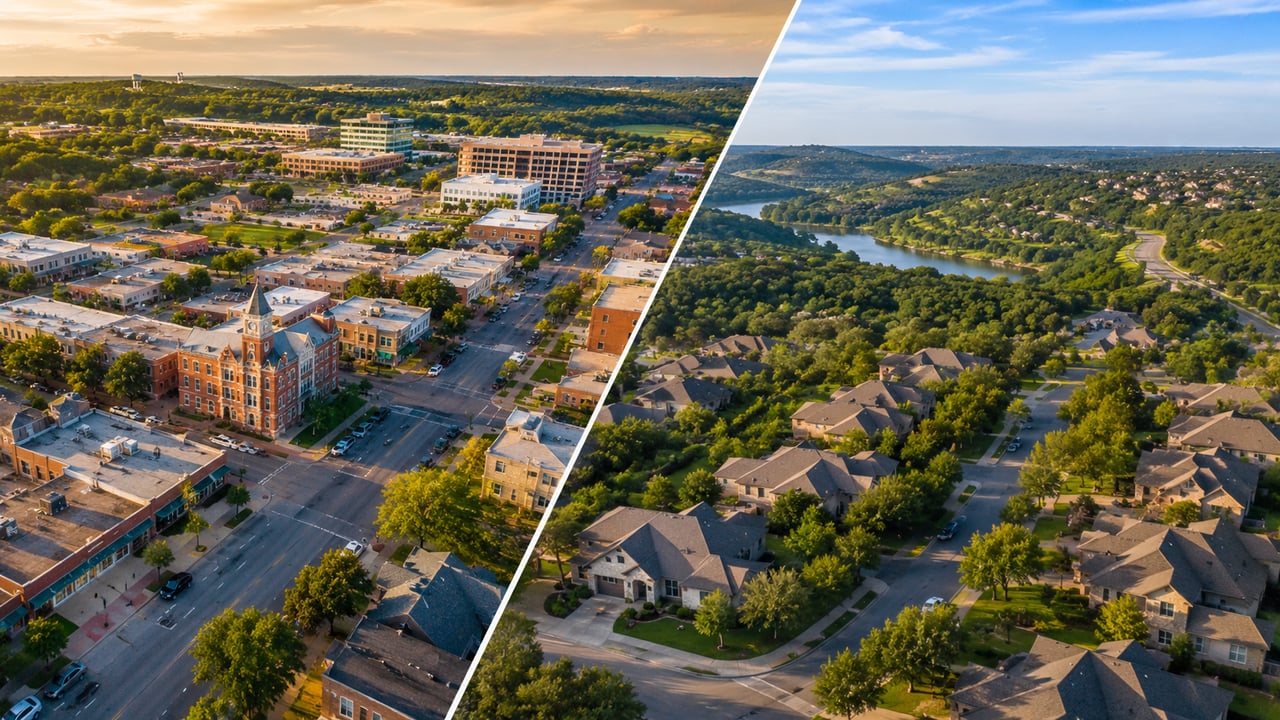
When comparing Round Rock vs Cedar Park Austin, both suburbs offer strong school districts, established infrastructure, and access to major employers north of the city — but they serve different buyer priorities. Round Rock tends to offer more inventory across a wider price range and a more established community feel, while Cedar Park skews slightly newer in its development, with strong lifestyle amenities and proximity to the 183A toll corridor. The right choice depends on your budget, commute, lifestyle, and how you weigh school district boundaries against neighborhood character.
By Maria Aguirre | June 25, 2026
Two of the most frequently compared suburbs in the Austin metro, Round Rock and Cedar Park consistently appear at the top of buyer searches north of the city. When evaluating Round Rock vs Cedar Park Austin, buyers are usually asking the same set of questions: Which one is more affordable? Which has better schools? Which gets me to work faster? Which fits the way my family actually lives?
This guide addresses each of those questions directly — with the local context buyers need to make a clear-headed comparison rather than relying on general metro statistics that do not reflect what is actually available in each community.
Round Rock vs Cedar Park Austin: How the Two Suburbs Compare on Price
Pricing in both suburbs has shifted considerably over the past several years, but as of recent market cycles, Round Rock has generally offered a slightly broader inventory range at the entry and mid-levels. Buyers can find established single-family homes in Round Rock starting in the mid-$300,000s, with the bulk of active inventory concentrated in the $400,000–$650,000 range depending on community, age of home, and lot size.
Cedar Park tends to skew slightly higher at comparable square footages, particularly in newer developments closer to the 183A corridor and communities like Buttercup Creek, Twin Creeks, and Brushy Creek. Entry points in Cedar Park have historically started in the high $300,000s to low $400,000s, with a strong concentration of inventory in the $450,000–$700,000 range.
Both markets have seen increased new construction activity, which affects resale pricing and buyer negotiating position. In subdivisions with active builder inventory, resale sellers are competing against new builds — a dynamic worth factoring into your offer strategy in either location.
For buyers with flexibility on location, the price difference between the two suburbs at a given square footage is often modest — but it can widen meaningfully depending on the specific neighborhood, school zone, and how recently the home was built.
Schools: What Buyers Need to Know About Round Rock ISD vs Leander ISD
School district boundaries are one of the primary drivers of buyer decisions in both suburbs, and the lines do not follow city limits cleanly.
Round Rock ISD serves the majority of Round Rock and portions of Pflugerville, Cedar Park, and Hutto. It is one of the largest and most consistently recognized school districts in Texas, with a strong track record across elementary, middle, and high school levels. McNeil High School, Westwood High School, and Round Rock High School are among the district's well-regarded campuses.
Leander ISD serves much of Cedar Park along with Leander and portions of northwest Austin. It has grown rapidly alongside the population of the corridor and has maintained strong academic ratings through that growth. Cedar Park High School and Vista Ridge High School are notable campuses within the district.
Because school district lines cut across both cities in some areas, buyers should verify which district and campus a specific address falls under before making a decision based on perceived school quality. A home listed as being in Cedar Park may fall within Round Rock ISD, and vice versa. [LINK: Austin area school district guide] covers how to verify district boundaries by address.
Commute and Location: Which Suburb Works Better for Your Route?
Geography shapes the commute calculation differently depending on where you are headed.
Round Rock sits directly on I-35 north of Austin, making it a straightforward drive to major employment corridors along the I-35 spine — including the Domain, the tech cluster around North Austin, and downtown Austin. The tradeoff is that I-35 is one of the most congested corridors in the state during peak hours. Round Rock also has direct access to SH-130, which offers an eastern bypass around Austin toward the airport and southeastern employment areas.
Cedar Park is positioned west of Round Rock along the 183A toll road, which provides a faster and more predictable commute alternative to I-35 for buyers heading into northwest Austin, the Domain, or employers along the 183 corridor. For buyers commuting to downtown Austin or south of the river, Cedar Park adds distance and time compared to Round Rock.
Remote and hybrid workers — a significant portion of the Austin metro buyer pool — may find the commute distinction less critical, in which case lifestyle, neighborhood character, and value per square foot become the deciding factors.
Lifestyle and Community Character
Beyond the numbers, Round Rock and Cedar Park have distinct identities that appeal to different buyer profiles.
Round Rock has the feel of a fully established city. It has its own downtown area, a recognized retail and dining corridor along University Boulevard and in the La Frontera development, and deep community roots anchored by institutions like Dell Diamond — home of the Round Rock Express — and the Old Settlers Park recreational complex. It draws buyers who want a suburb with its own civic identity rather than one that feels like an extension of Austin.
Cedar Park leans newer and more amenity-driven in its newer developments. Communities like Twin Creeks and Buttercup Creek are built around trail systems, community pools, and neighborhood parks. The H-E-B Plus and surrounding retail along Whitestone Boulevard anchor daily life for much of the city. Cedar Park also has a growing restaurant and local business scene, though it is somewhat less established than Round Rock's.
Buyers relocating from other metros often gravitate toward Cedar Park for its newer housing stock and planned community infrastructure, while buyers who have spent time in the Austin area and want a more rooted community feel often prefer Round Rock.
According to the U.S. Census Bureau, both Round Rock and Cedar Park rank among the fastest-growing cities in Texas — a signal of sustained demand but also a reminder that both markets continue to evolve quickly.
For buyers exploring the full range of Austin area suburbs, [LINK: Austin suburb comparison guide] covers additional communities worth considering depending on your priorities.
What This Means for Austin Area Home Buyers
The Round Rock vs Cedar Park Austin decision rarely comes down to one factor. Most buyers are weighing a combination of price, school district, commute, and lifestyle — and the right answer depends on how those priorities stack up for your specific situation.
A few practical filters worth applying:
If commute to downtown or south Austin is a priority, Round Rock's I-35 access gives it an edge in terms of directness, though not necessarily speed during peak hours. If commute to northwest Austin or the 183 corridor is the priority, Cedar Park's 183A access is a meaningful advantage. If school district research reveals that the specific neighborhood you are considering falls within your preferred district regardless of city, that may settle the question entirely. And if budget is the primary constraint, comparing active inventory in both markets at your price point — rather than relying on median figures — will give you the clearest picture of what you can actually get for your money in each location.
Frequently Asked Questions About Round Rock vs Cedar Park Austin
Is Round Rock or Cedar Park more affordable for home buyers?
Round Rock has historically offered a slightly broader range of inventory at the entry and mid-price levels, with homes starting in the mid-$300,000s. Cedar Park entry points tend to start slightly higher, particularly in newer developments. The gap at comparable square footages is often modest, but it can widen depending on the neighborhood and school zone. Comparing active listings at your specific budget in both markets gives a more accurate picture than median price comparisons alone.
Which suburb has better schools — Round Rock or Cedar Park?
Both Round Rock ISD and Leander ISD have strong academic reputations and are among the more consistently rated districts in the Austin metro. The better choice depends on which specific campuses serve the address you are considering — and those lines do not follow city boundaries cleanly. Always verify the district and campus assignment for a specific address before making a school-driven decision.
Which suburb has a better commute to Austin?
It depends on your destination. Round Rock offers more direct I-35 access for commuters heading downtown or south. Cedar Park's 183A toll road is faster and more predictable for commuters heading to northwest Austin or the Domain. For remote workers, the commute distinction matters less and lifestyle factors become more important.
Is Cedar Park or Round Rock better for families?
Both suburbs are consistently ranked among the more family-friendly communities in the Austin metro, with strong school districts, park systems, and community amenities. Cedar Park's newer planned communities appeal to buyers who want newer housing stock and trail-connected neighborhoods. Round Rock's more established civic infrastructure appeals to buyers who want a suburb with its own identity and history.
Are there new construction options in both Round Rock and Cedar Park?
Yes. Both suburbs have active new construction in various price ranges. Builder activity in both markets means resale sellers are competing against new inventory in some neighborhoods — which can affect pricing and negotiating dynamics. Your agent should identify where active builder communities exist relative to the resale homes you are considering.
Ready to Choose Your Austin Area Suburb?
Comparing suburbs is one of the first decisions Austin area buyers face — and it shapes everything that follows in your search. If you want a clearer picture of what your budget gets you in Round Rock vs Cedar Park right now, based on current active inventory, let's talk through it.
Maria Aguirre is a bilingual REALTOR® at Keller Williams Lake Travis with $50M+ in career sales and 250+ families served across the Austin area. Certified CLHMS, GRI, and CIPS. Connect at https://mariaaguirrehomes.com/.