The Decision Nobody Told Me About (Until It Cost Me $15,000)
A buyer closed on her first Austin home in November 2025.
She was excited. She had the keys. She started moving in.
Then, in January 2026, I asked her: "Did you apply for your homestead exemption?"
She looked confused. "What's that?"
I explained. Her face fell.
By waiting until 2026 to apply, she missed the 2025 tax year exemption. She'll get it starting 2026 taxes (filed 2027). But that one-year delay? It costs her approximately $15,000 in extra property taxes over the life of her loan.
One timing decision. $15,000 consequence.
This is the Austin wealth move that nobody explains—and almost everybody gets wrong.
What Is the Homestead Exemption (And Why Texas Has It)
Texas has no state income tax. Instead, the state relies on property taxes.
To make homeownership accessible, Texas offers the homestead exemption: a property tax break for primary residences.
Here's how it works:
Without exemption: Home assessed at $450,000. Tax rate 1.8%. Annual taxes: $8,100.
With exemption: Home assessed at $450,000, but $25,000 of value is exempt from taxation. Taxable value: $425,000. Tax rate 1.8%. Annual taxes: $7,650.
Difference: $450/year.
That doesn't sound huge, right?
But over 30 years, that's $13,500 in savings. And that's conservative—it doesn't account for property value appreciation or tax rate increases over time.
Some estimates put the 30-year savings at $30,000-$50,000+ depending on neighborhood, appreciation, and tax adjustments.
The Timing Decision That Changes Everything
Here's where most buyers get it wrong:
When you close: Let's say you close November 15, 2025.
The decision: Do you apply for homestead exemption in 2025 (before year-end) or 2026 (after you've moved in)?
What most buyers do: They apply in 2026 because everything is chaotic. Moving, closing, setting up utilities. Homestead exemption feels like something you'll handle "later."
What actually happens: If you apply in 2026, you get the exemption starting in the 2026 tax year (taxes filed 2027).
But if you'd applied before December 31, 2025, you'd get the exemption in the 2025 tax year (taxes filed 2026).
One year difference. That one year of taxes without exemption? You're paying full price on a $450,000 home when you could have been getting the exemption from day one.
The math: Year 1 of homeownership, you pay an extra $450 in taxes because you missed the exemption deadline.
But here's what most people don't realize: property tax exemptions compound. You're not just missing one year. Property values appreciate. Tax rates increase. That $450 "missed" in year one becomes $500, then $550, then $600 in subsequent years as values grow.
Over the life of your mortgage, that one timing decision compounds into $15,000+ in additional taxes.
The Austin/Travis County Specific Numbers
Let me be specific about what this means in your county:
Travis County (City of Austin proper):
- Average home price: $550,000+
- Property tax rate: ~1.8-1.9%
- Without exemption first year: ~$10,450
- With exemption first year: ~$9,950
- Year 1 savings: ~$500
- 30-year compounding savings: ~$18,000-$25,000+
Williamson County (Cedar Park, Leander, Round Rock):
- Average home price: $475,000
- Property tax rate: ~1.6-1.7%
- Without exemption first year: ~$7,600
- With exemption first year: ~$7,150
- Year 1 savings: ~$450
- 30-year compounding savings: ~$13,500-$20,000
Hays County (Kyle, Buda, Dripping Springs):
- Average home price: $425,000
- Property tax rate: ~1.5-1.6%
- Without exemption first year: ~$6,800
- With exemption first year: ~$6,375
- Year 1 savings: ~$425
- 30-year compounding savings: ~$12,750-$19,000
These aren't small numbers. These are generational wealth decisions.
Why the Timing Actually Matters (Beyond Year 1)
Here's the deeper thing nobody explains:
The homestead exemption doesn't just save you money in year one. It affects the baseline of your property's taxable value going forward.
If you get the exemption in 2025, your baseline taxable value in subsequent years is lower. Property appreciates. Taxes increase. But they're always calculated on that lower baseline.
If you miss 2025 and apply in 2026, your baseline taxable value is higher from the start. For the next 30 years, you're calculating taxes on a higher baseline.
Simple example:
Applied 2025: Baseline taxable value $425,000. Year 10 (with appreciation): $525,000 taxable. Taxes: $9,450.
Applied 2026: Baseline taxable value $450,000. Year 10 (with appreciation): $550,000 taxable. Taxes: $9,900.
Year 10 difference: $450. Multiply that by 20 remaining years of your mortgage. You're looking at $9,000+ in additional taxes because you missed a deadline.
Here's My Framework (How I Help Buyers Get This Right)
This is where most real estate agents drop the ball. They don't track homestead exemption timing. They don't proactively help buyers understand the deadline.
Here's what I do:
Step 1: Identify Your Closing Timeline
When are you closing? What county? What school district?
Step 2: Calculate Your Specific Savings
I use your projected home value + county tax rate + family size (some exemptions vary) to calculate YOUR specific 30-year savings.
Not generic numbers. Your numbers.
Step 3: Identify the Deadline
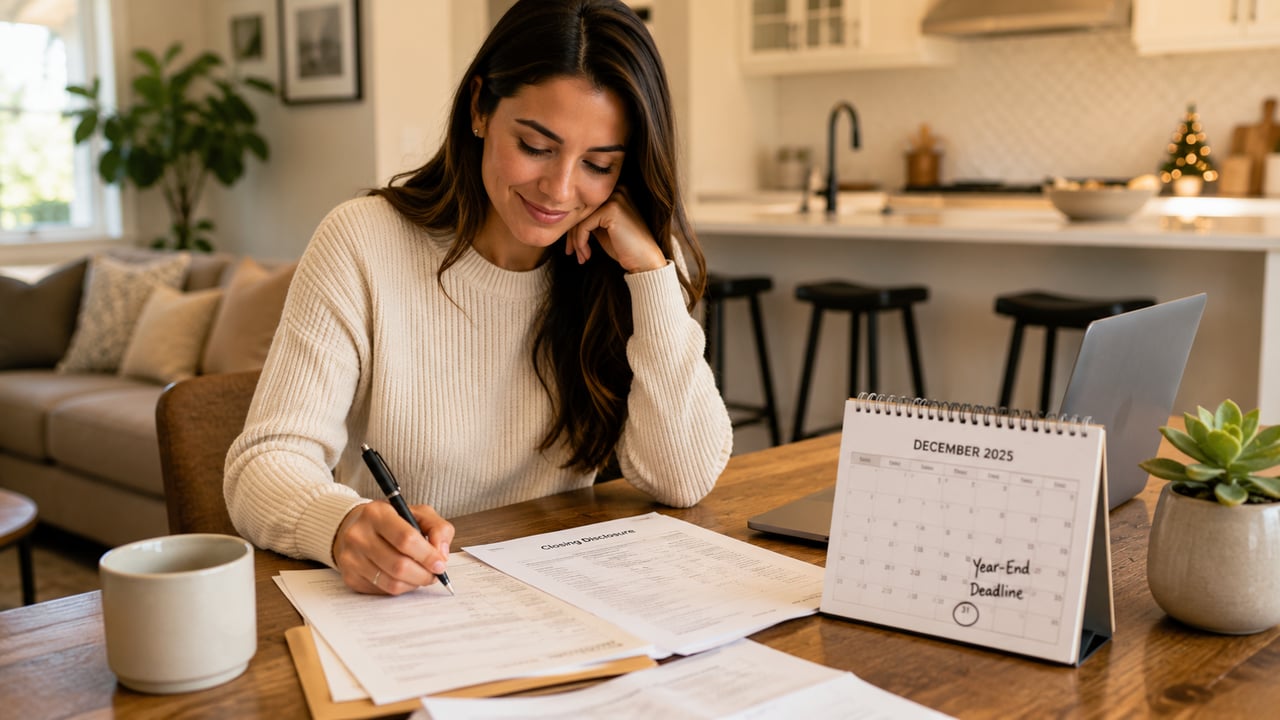
This is critical: The homestead exemption deadline for your county's 2025 tax year is December 31, 2025 (if you close before then) or the equivalent deadline in 2026 (if you close in 2026).
But most counties are moving to digital applications, and deadlines vary by county appraisal district.
I track these deadlines. Most agents don't. Most buyers definitely don't.
Step 4: Execute BEFORE Closing
If your closing is before year-end and you'll be moved in by December 31, we apply for homestead exemption before closing.
You get the exemption immediately. You start saving in year 1.
If your closing is after year-end, we apply immediately after closing using your final closing documents.
Step 5: File the Homestead Claim
This is the step most people skip or delay. I make sure it's filed correctly, on time, with the right county appraisal district.
Different counties have different processes:
- Travis County: Online through Travis Central Appraisal District
- Williamson County: Online through Williamson County Appraisal District
- Hays County: Online or in-person with Hays County Appraisal District
The Real-World Example: Maria's Approach
I had a buyer close on a $525,000 home in December 2025 in Travis County.
Because we tracked the deadline, we filed her homestead exemption application in her closing documents package.
30-year savings: ~$22,000.
Without proactive coordination? She'd have delayed filing until 2026. Year 1 alone: $450 wasted. But compounded over 30 years with appreciation? $22,000 cost.
That's the difference between having someone who understands the full financial picture and having someone who just closes transactions.
The Question You Should Ask Your Realtor
Before you close, ask: "When is the homestead exemption deadline for my county? Are we filing before or after closing? What's my specific projected savings?"
If your realtor doesn't know or seems confused, that's a signal.
The homestead exemption is one of the few Texas tax benefits directly available to homebuyers. Not knowing it, not timing it right, not filing it proactively—that's a massive oversight.
FAQ: Homestead Exemption Questions
Q: Can I apply for homestead exemption after I close?
A: Yes, but you miss the year-of-closing exemption. You'll get it starting the next tax year, which means missing one year of savings.
Q: What if I bought late in the year (November/December)?
A: Timing matters. If you close and get your keys by December 31, you can usually file for that year's exemption. If you close in January, you'll file for the next year. This is why coordination with your realtor matters.
Q: Do I need to own the home outright to get homestead exemption?
A: No. You just need to own it and live in it as your primary residence. The lender doesn't affect your exemption.
Q: What if I'm married but only one spouse is on the title?
A: Both spouses can claim homestead exemption if you're married and it's your primary residence. Documentation varies by county.
Q: Can I apply for homestead exemption if I'm still renting out a room?
A: Generally yes, as long as it's your primary residence and you live there. Airbnb or rental situations are more complex—ask your county appraisal district.
Q: What if my property value increases significantly after I get the exemption?
A: The exemption applies to the assessed value, not a fixed dollar amount. As your home appreciates, your taxable value grows, but the exemption still applies. You still get the benefit.
Q: How long does homestead exemption last?
A: As long as it remains your primary residence. If you move and it becomes a rental, you lose it. If you move back in, you can reapply.
Q: Can I get homestead exemption on a second home or investment property?
A: No. It's exclusively for primary residences. You can only claim homestead exemption on one property.
The homestead exemption is one of the most valuable tax benefits Texas offers homebuyers—but only if you understand the timing and execute proactively. Most buyers leave $15,000-$50,000 on the table by missing this.
I don't just help you close; I help you optimize every financial advantage available. That includes making sure your homestead exemption is filed correctly and on time so you're not paying taxes you don't have to.
If you're buying in Austin and want to maximize your wealth-building from day one, let's talk about your specific situation and your specific projected savings.
(512) 217-3961
[email protected]
— Maria Aguirre
Mi Casa Agency | Keller Williams Lake Travis