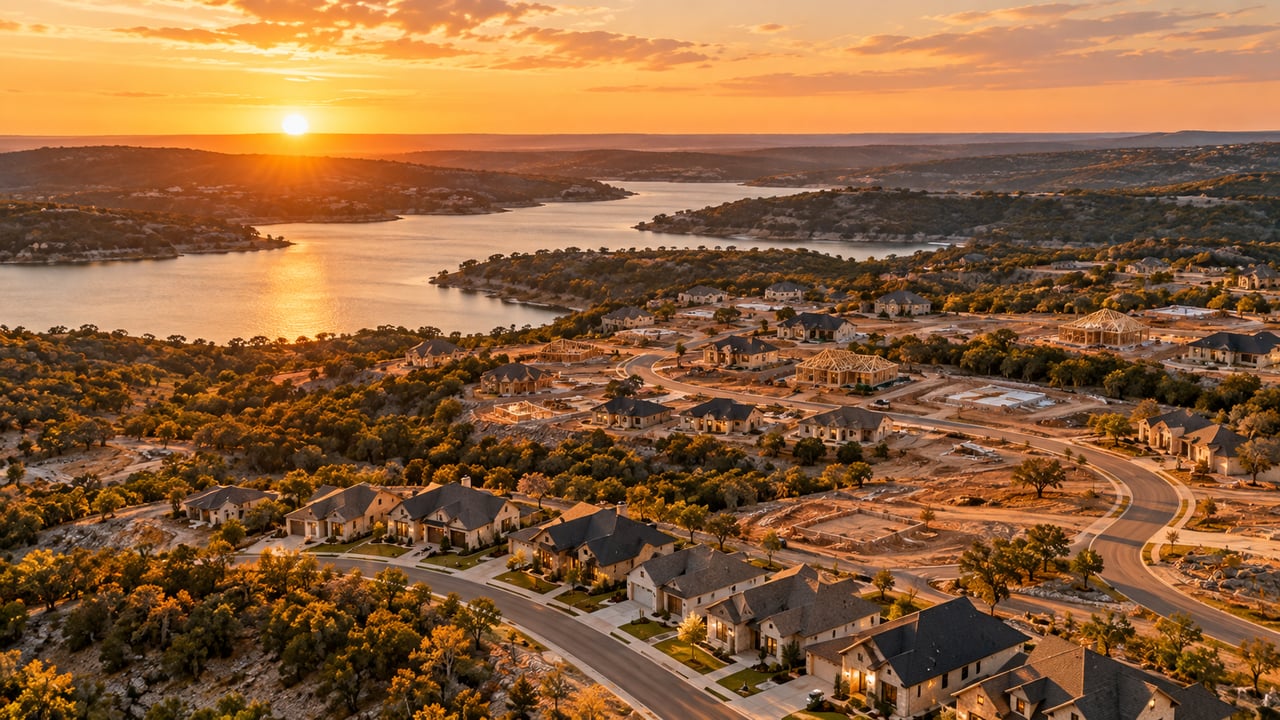
Drive up Mayfield Ranch Boulevard in northwest Round Rock and you will pass two houses, on the same street, in the same subdivision, with kids who might ride the same bus stop bench in the morning and then split off toward two different high schools. One heads to Round Rock ISD's Stony Point. The other heads to Leander ISD's Rouse. The property line that separates them doesn't show up in a drone photo or a curb appeal shot. It shows up on a school boundary map, and it can move a listing's asking price by tens of thousands of dollars depending on which side of the line the front door sits.
That split street is a small, visible version of a much bigger contradiction playing out across Round Rock right now. If you've been watching the headlines, you've probably seen the topline number: citywide, the market is cooling. Over the three months ending in June 2026, Round Rock's median sale price was $373,000, down 5.6 percent from the same period a year earlier, with homes now taking 58 days to sell on average compared to 54 days last year.
That number is accurate. It's also hiding two very different markets moving in opposite directions underneath it.
The Neighborhoods That Didn't Get the Memo
While the citywide median slid, Teravista's median sale price climbed to $485,000 over the same window, up 5.7 percent year over year. Walsh Ranch's average home value reached $894,494 as of the end of June 2026, up 2.6 percent from a year earlier. These aren't rounding errors. They're two of Round Rock's most recognizable master-planned communities moving against the citywide current at the same time everyone else is watching prices soften.
If you're comparing neighborhoods with a single "Round Rock median price" line item on a spreadsheet, that line item is telling you almost nothing about whether the specific street you're considering is getting more or less competitive. The real story is three separate mechanisms, each doing its own work on a different part of the map.
School district boundaries that cut through single subdivisions. Most of Round Rock falls under Round Rock ISD, one of the stronger districts in the region. But a band of northwest neighborhoods, including sections of Mayfield Ranch and Walsh Ranch, straddle the Leander ISD line instead. Within Mayfield Ranch alone, the original 2003 to 2011 section and Vista Oaks fall under Round Rock ISD, while the newer, higher-priced Highlands at Mayfield Ranch section falls under Leander ISD. Two homes a few hundred feet apart, built by the same builder in the same community, can be zoned to entirely different districts. Buyers chasing a specific school assignment will pay a premium for the right address, and that premium shows up in the neighborhood-level averages even as the citywide number falls.
Amenity tiers that justify their own pricing. Teravista isn't holding value because of location alone. It's an 18-hole golf course community with resort-style pools, a fitness center, and an HOA that bundles those amenities into the price of admission. That kind of packaged lifestyle draws a buyer who isn't shopping the citywide median. They're shopping a specific set of amenities, and they'll pay for lot position along the fairway the same way a lakefront buyer pays for water frontage.
A live construction site that's about to change the map. This is the mechanism most buyers researching Round Rock right now haven't priced in yet, because it's still under construction.
The $500 Million Project Rising Across From Dell's Headquarters
Just south of State Highway 45 and northwest of Greenlawn Boulevard, a California developer named Mark IV Capital is building something Round Rock has been waiting on since 2017: a 65.5-acre mixed-use district sitting almost directly across from Dell Technologies' global headquarters.
The project, called simply The District, broke ground in March 2025 after nearly six years of planning revisions. It has grown considerably since its first pitch. What started as a $200 million, 1 million-square-foot proposal has expanded into a campus expected to exceed $500 million in private investment, with some reporting suggesting it could top $1 billion by the time it's fully built out. The city's development agreement sets binding milestones: at least 200,000 square feet completed by 2028, 1 million square feet by 2029, and a minimum of 3 million square feet, including 600,000 square feet of commercial and retail space, by 2039.
In February 2026, Mark IV secured an $86 million construction loan to finance the first phase, and construction went vertical the following month. The headline piece of that first phase is Origin at The District, a seven-story, 316-unit luxury apartment building with more than 23,000 square feet of ground-floor retail and amenities built to compete at the top end of the suburban Austin rental market, including a pool deck, cold plunge, and dry sauna. The contractor's project lead told local reporters the building's timeline has actually shortened, from 28 months to 24 to 26 months, putting delivery sometime in 2028. Mayor Craig Morgan called the project transformational for the city at the March groundbreaking.
None of this shows up in a median price calculation yet. Origin isn't finished. The office towers and hotel component that round out the full plan are years away. But the corridor around Greenlawn Boulevard and I-35 is about to absorb thousands of new residents, a wave of retail leasing, and the kind of foot traffic that reshapes demand for everything within a short drive, including the existing single-family inventory nearby. Round Rock's downtown has already been rezoned to allow taller mixed-use buildings in anticipation of exactly this kind of growth pressure. A buyer evaluating a home near that corridor today is buying into a neighborhood that will look materially different in three years, in a way a buyer near Old Town or the city's more established interior neighborhoods, further from the construction, is not.
What This Actually Means If You're Comparing Neighborhoods
None of this means Teravista or Walsh Ranch are automatically the right call, or that a home near The District is guaranteed to appreciate faster than one in an established, tree-lined section of the city. It means the citywide median is the wrong tool for the comparison you're actually trying to make. Three practical steps matter more than the headline number:
Confirm school zoning by the actual address, not the subdivision name. If a specific district assignment is part of why you're considering a neighborhood, don't assume the whole community shares one boundary. Ask for the parcel-level zoning confirmation before you fall for a house.
Ask what the HOA fee is actually buying. A golf course community and a standard suburban subdivision can carry similar list prices with very different monthly costs attached. That gap changes your real monthly payment even when the sale price looks comparable on paper.
Ask how close you'll be to active construction, and for how long. Proximity to The District might be a long-term upside for resale and rental demand. It might also mean several years of construction traffic and noise before that upside shows up. Both are true at once, and a buyer should walk in knowing which trade-off they're accepting.
A Few Questions Worth Asking Before You Compare Neighborhoods
Is Round Rock currently a buyer's market or a seller's market? Citywide data through mid-2026 shows longer days on market and a softer median price compared to a year earlier, conditions that generally favor buyers on price negotiation. Individual neighborhoods with strong amenities or in-demand school zoning are behaving differently, so the answer depends heavily on which specific area you're comparing.
When will The District actually be finished? The full build-out runs through 2039 under the city's development agreement, but the first residential phase, Origin, is expected to deliver around 2028. Retail and additional phases will roll out over the following years rather than arriving all at once.
Does a home's HOA amenities affect its resale value? Amenity-rich communities like Teravista tend to hold value differently than standard subdivisions because they draw a buyer shopping for a specific lifestyle package, not just square footage. That can mean more price resilience during a broader market cooldown, though it also means a higher ongoing HOA cost to weigh against that resilience.
If you're trying to figure out what a specific Round Rock street is actually worth right now, and whether it sits on the resilient side of this split or the softening side, that's a conversation worth having with someone who tracks these boundaries block by block. Maria Aguirre works across Round Rock and the surrounding Austin metro in both English and Spanish, and can walk you through exactly what a given address is zoned for, what its HOA actually covers, and how close it sits to what's coming next. Request a free home valuation and let's talk. Hablemos.
This article is general information, not legal, tax or financial advice. Consult a qualified professional about your situation.