The Conversation I Had This Morning
A luxury buyer called me today. She'd been dreaming about waterfront on Lake Travis for five years.
"I didn't think I could afford it," she said. "But someone told me the market has softened. Is that true? Am I actually able to buy waterfront now?"
I told her the truth: "Yes. And if you're serious, you need to move on it. This window doesn't stay open forever."
Here's what's happening in the Lake Travis waterfront market in 2026—and why it matters.
What's Changed (And Why It's Significant)
For the past three years, Lake Travis waterfront was seller's market. Inventory was scarce. Prices were climbing. If you wanted waterfront, you competed, you paid premium prices, and you moved fast.
That world has shifted.
Waterfront inventory is up. Days on market have extended from 30-45 days to 60-100+ days. Sellers who priced aggressively are now motivated.
But—and this is important—waterfront has held value better than non-waterfront in the Lake Travis area.
Here's the data:
Non-waterfront Lakeway homes have seen 6-23% price declines depending on the segment. The middle market ($600K-$900K) is seeing significant price reductions. Homes that were priced for 2022 values are sitting.
Waterfront homes? They're still holding value. Premium waterfront estates have remained "remarkably resilient."
Why?
Waterfront is scarce. Truly scarce. There are only so many private waterfront lots left on Lake Travis. Buyers understand that supply is finite. And finite supply drives value, even in soft markets.
The Brutal Honesty About Lake Travis Waterfront
Before I tell you why now is your window, I need to be honest about what waterfront on Lake Travis actually is.
Lake Travis is a reservoir managed by LCRA (Lower Colorado River Authority). Water levels fluctuate based on rainfall and management decisions.
This is not Lake LBJ (which is constant-level and commands a premium). This is not the ocean (which never drains). This is a Texas hill country reservoir that can drop during drought.
In 2025, we had Stage 2 drought restrictions. Austin carries an "Extraordinary Drought" classification risk. That's real, and you need to understand it.
Does this mean you shouldn't buy waterfront? No. It means you should buy with clear eyes about what waterfront means here.
Some buyers want the dock experience—boating access, launching kayaks, playing on the water. For them, water level fluctuations matter.
Other buyers want the view—panoramic vistas over the water, sunset moments, the lifestyle that comes with living on the shore. For them, water levels matter less.
Understand which one you are before you buy.
Why This Window Matters
For five years, Lake Travis waterfront buyers faced brutal math:
- Limited inventory
- High prices
- Competition
- No negotiation leverage
Today's math is different:
- More inventory (waterfront homes on market have increased)
- Motivated sellers (homes sitting longer mean sellers are ready to negotiate)
- Extended timelines (you're not in a race)
- Negotiation leverage (you can actually ask for things)
This is the difference between a seller's market and a buyer's market.
In a buyer's market, waterfront becomes accessible to buyers who couldn't compete in the seller's market.
But—and here's the catch—this window doesn't stay open forever.
Austin's market is showing signs of stabilization. Leading indicators are improving month-over-month. Spring 2026 momentum suggests we're finding a floor.
Once that happens, waterfront inventory will tighten again. Sellers will become less motivated. Prices will stabilize and eventually appreciate.
The window for buying waterfront at soft prices with negotiation leverage is now.
Not in six months. Not after things "stabilize." Now.
What You Actually Get (And What You Don't)
Let me be clear about what waterfront means on Lake Travis:
What You Get:
- Direct water access (typically)
- Private dock (in many cases, though this varies dramatically)
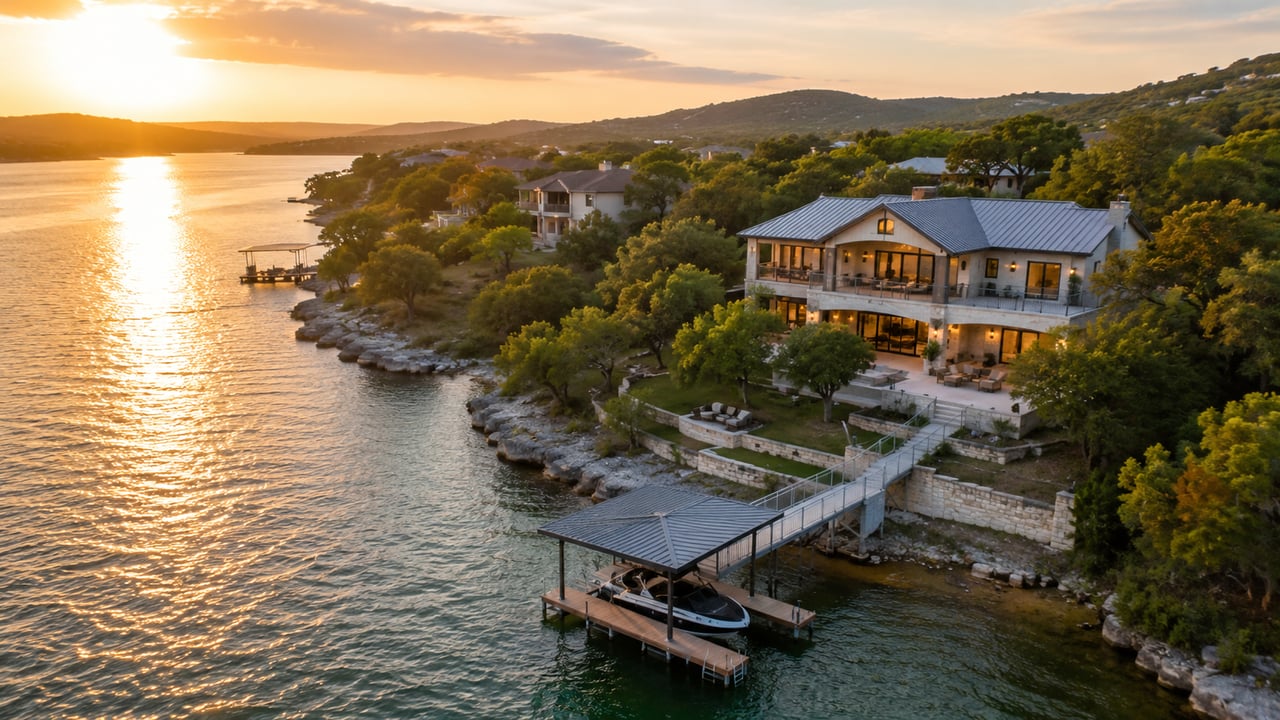
- Waterfront lifestyle—morning coffee overlooking water, sunset views, boat access
- Community that's built around water recreation
- Scarcity value (limited inventory, limited supply)
- Historical appreciation resistance (waterfront has historically held value through market corrections)
What You Don't Get:
- Guaranteed dock access year-round (depends on water levels)
- Stable water levels (Lake Travis fluctuates; you need to accept that)
- Freedom to build/modify dock structures (LCRA permits required, and they're not always granted)
- Predictable commute (30-40 min with no traffic, 50-70 min peak hours; RM 620 is a bottleneck until 2030)
Understand both sides before committing.
The Three Waterfront Questions You Need to Answer
Before you buy waterfront on Lake Travis, answer these clearly:
1. What Are You Actually Buying Waterfront For?
Dock access? Views? Lifestyle? Water recreation? Something else?
Be honest. I've worked with buyers who bought waterfront expecting boating lifestyle, then realized they're not actually boaters. They wanted the idea of waterfront, not the reality.
Different answer = different property strategy.
2. Can You Accept Water Level Fluctuations?
Some years Lake Travis is full. Some years it's down 10-15 feet. That affects dock usability, aesthetic experience, and resale appeal.
If water level fluctuation stresses you, waterfront might not be right.
3. Do You Actually Want to Live on the Lake Full-Time, or Are You Looking for a Getaway?
Lake Travis communities have two types of waterfront: primary residences and second homes.
Primary residence waterfront = you live there full-time, your commute matters, your lifestyle is built around the lake.
Second-home waterfront = you visit weekends/summers, you're not commuting, it's purely about lifestyle.
These have very different economics and motivations.
Be clear about which one you actually want.
The Communities You Should Know About
Lakeway
The established waterfront community on Lake Travis. Mix of $800K-$1.3M+ homes, marina access, golf, established neighborhoods.
Most inventory, most price variation. Older Lakeway (built 1970s-1990s) is seeing slower sales unless significantly updated. Newer builds and updated homes are moving.
Days on market: 60-90 days for non-waterfront; extended for waterfront.
Rough Hollow
Master-planned community within Lakeway area. Newer construction, resort-style amenities, marina, pools, trails.
Homes $600K-$1.5M+. More modern, more amenity-rich than older Lakeway.
Days on market: 60-80 days; attracting buyers looking for newer construction with waterfront access.
Bee Cave
Not directly waterfront but close to Lakeway/Lake Travis. Growing community with shopping, dining, newer residential options.
More affordable entry point to Lake Travis lifestyle without full waterfront premium.
Spicewood (Travis Club)
Emerging luxury development. 1,500 acres on Lake Travis shore. Championship golf course opening mid-2026.
This is the development story of 2026 for Lake Travis. Will define luxury waterfront for next decade.
Premium pricing but newest construction, most amenities.
The Waterfront Pricing Reality
Waterfront inventory has increased, but prices are still stratified:
Entry-Level Waterfront: $600K-$800K
- Smaller homes, may need updating
- Shorter dock access
- Older construction
- Still premium pricing for waterfront
Mid-Range Waterfront: $800K-$1.3M
- Mix of updated and original homes
- Better dock access
- Established neighborhoods
- Where most inventory sits right now
Premium Waterfront: $1.3M-$2M+
- Custom builds, newer construction
- Significant dock infrastructure
- Private amenities
- Higher demand, less negotiation leverage
Ultra-Luxury Waterfront: $2M-$20M+
- Custom estates with private docks, boat lifts
- Premiere communities (Spicewood, exclusive Lakeway sections)
- Limited supply, still appreciating
The sweet spot for negotiation leverage? Mid-range waterfront ($800K-$1.3M). This is where inventory is highest and sellers are most motivated.
Why Waterfront Is Recession-Resistant
Here's something most people don't understand: waterfront has historically held value through market corrections better than non-waterfront.
Why?
Scarcity. You can build more houses in suburban neighborhoods. You cannot create more waterfront. There's only so much shoreline on Lake Travis.
Buyers who can afford waterfront are usually less rate-sensitive than first-time buyers. If rates go to 7%, a buyer paying $1.2M for waterfront is still buying (they weren't price-squeezed into that market).
Waterfront serves dual purposes—primary residence AND investment/second home. Demand is more stable.
This doesn't mean waterfront never declines. It means waterfront typically declines less than the broader market in corrections, and appreciates more in growths.
If you're buying for long-term wealth-building (5-10+ years), waterfront is strategically sound.
How to Position Your Offer
You have leverage right now. Use it wisely.
Price Aggressively but Fairly
Don't lowball, but don't overpay either. Sellers have been sitting. They know current market. Use comparable sales data.
Negotiate Terms, Not Just Price
Interested rate buydowns, repair credits, closing cost assistance, flexible closing timelines. These are worth negotiating and often easier for sellers than price reductions.
Shorten Inspection Period
Show decisiveness. Offer 5-day inspection instead of 10 days. This makes your offer feel serious without eliminating your protection.
Pre-Inspect Before Offering (If Possible)
Pay $400-600 for pre-inspection before making offer. You now know condition and can negotiate from strength.
Ask Questions About Dock Access
Get clarity on LCRA permits, dock infrastructure, water level history, dock maintenance costs. This might affect your negotiation.
FAQ: Lake Travis Waterfront Questions
Q: Should I buy waterfront if water levels are down?
A: No. Buy when water is normal-to-full. You want to see the property under normal water conditions, not drought conditions.
Q: What are typical LCRA dock permit restrictions?
A: Varies, but generally: docks have maximum length/width, boat lifts have restrictions, permanent structures require permits. Your title company and realtor should research this before you offer.
Q: Is waterfront a good investment?
A: Yes, historically. Waterfront has held value through corrections and appreciates in recoveries. But only if you can afford it without stretching and can live with water level fluctuations.
Q: What's the difference between Lake Travis and Lake LBJ?
A: Lake Travis fluctuates; Lake LBJ is constant-level. Lake LBJ commands premium pricing because dock access is always reliable. Lake Travis is more affordable but requires accepting water level changes.
Q: How much should I budget for dock maintenance?
A: $1,000-3,000+ annually depending on dock size and condition. Get a dock inspector to quote specific maintenance needs.
Q: Is the commute from Lake Travis to Austin reasonable?
A: 30-40 minutes with no traffic; 50-70 minutes peak hours. RM 620 is the bottleneck. If you work downtown daily, this is a strain. If you work from home or commute occasionally, it's fine.
Lake Travis waterfront is a deeply personal decision—balancing lifestyle dreams with financial reality, dock access with water level fluctuations, and waterfront premium with long-term value. I welcome the opportunity to walk through specific waterfront properties, explain what waterfront really means in this market, and help you understand whether this is the right time and the right property for your family.
If you're serious about Lake Travis waterfront, let's have a real conversation about what you're buying and why—and whether now is your actual window.
(512) 217-3961
maria@micasaagency.com
— Maria Aguirre
Mi Casa Agency | Keller Williams Lake Travis