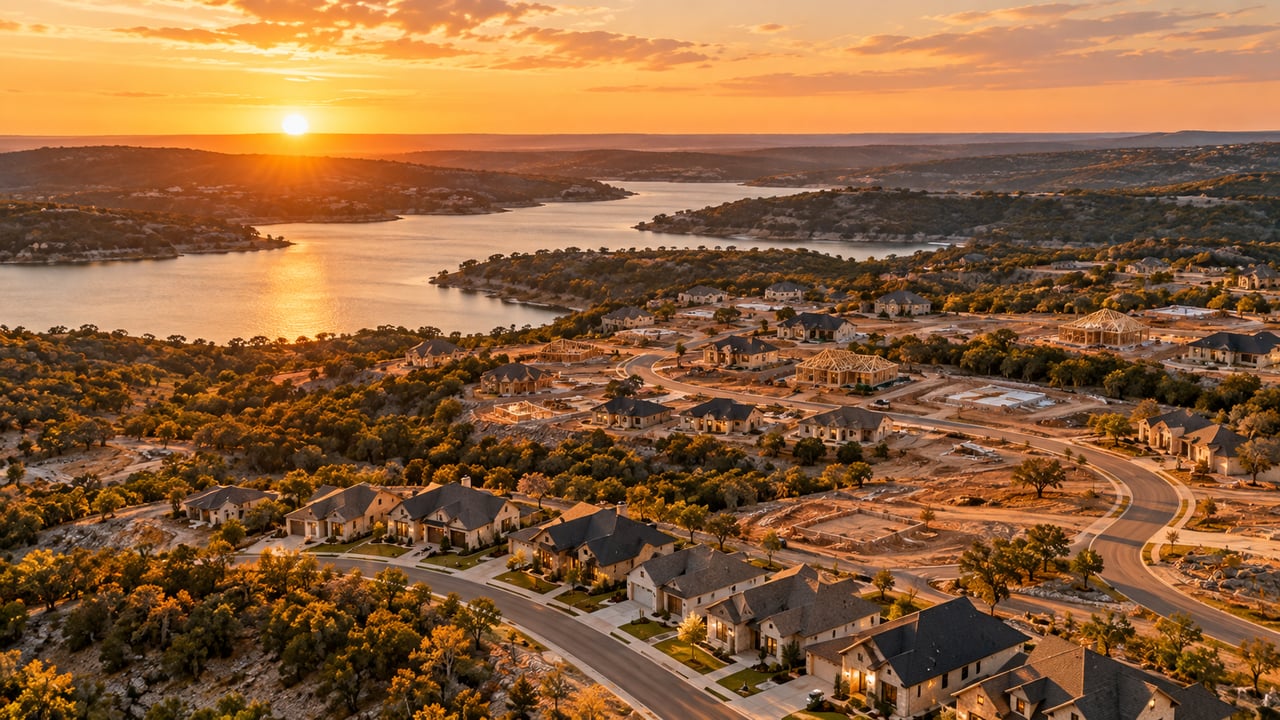
Lake Travis was 99.2 percent full as of August 9, 2026, according to Water Data for Texas, sitting right at the 681-foot full pool mark the lake reached in July for the first time since 2019. Coves that were mudflats a few summers ago are open water again. Docks that sat on dry ground are floating. Every waterfront listing photo taken this month is going to look its absolute best.
That is also exactly the wrong moment to stop asking questions about a dock. Full pool does not last on this lake, and it never has. What determines whether a waterfront purchase holds up isn't what the water looks like in August 2026. It's what happens to that specific dock, on that specific lot, the next time the lake does not cooperate.
"Waterfront" Doesn't Mean What It Says on Every Lake
On a lot of reservoirs, a fixed dock is shorthand for reliable water. If the pilings are set and the water reaches them, the lake is stable enough that someone engineered a permanent structure around it. Lake Travis breaks that shorthand. It is a working reservoir, not a natural lake, managed by the Lower Colorado River Authority for water supply and flood control. Levels move with rainfall, downstream demand, and flood operations at Mansfield Dam, and the swings are not small. A fixed pier calibrated to today's water line can be sitting on dry rock the next time the lake pulls back. That is why the term "waterfront" on a Lake Travis listing needs a follow-up question, not a checkmark.
Why Most Docks on Lake Travis Float
LCRA's own dock safety materials put a number on this: more than 3,700 floating docks sit on lakes Travis and Buchanan combined. On Lake LBJ, where the pool stays comparatively constant behind its own dam, fixed docks are common and unremarkable. On Travis, they are close to nonexistent, because a structure bolted to a fixed elevation cannot follow a lake that can move by dozens of feet in a single dry year. Floating docks solve that problem by rising and falling with the surface. The tradeoff is that a floating dock is only as good as the water underneath it, which brings the conversation back to where a given lot actually sits on the lake.
The Lake Has Done This Before, and Recovery Took Years
Full pool feels permanent when you are standing on a dock in August. It has not been permanent in the past.
| 2011 drought low | Today (August 2026) | |
|---|---|---|
| Water level | Roughly 620 feet AMSL | Near full pool (99.2 percent full as of August 9, 2026) |
| Distance below full pool | More than 60 feet | Not specified |
| Cove docks | Stranded on exposed lakebed | Floating, fully usable |
| Boat ramps lakewide | Many closed or extended with temporary ramps | Fully open |
The 2011 to 2015 drought pulled the lake down for years, not months, and the properties that suffered most were not spread evenly across the shoreline. Cove lots, especially ones fed by seasonal creek arms rather than the main river channel, lost their water first and got it back last. Open-water lots on the main lake body, where the channel holds real depth even at low pool, kept functioning docks through most of the drought. That difference in outcome, not the drought itself, is the part worth carrying into a 2026 purchase decision.
Cove or Open Water Is the Question That Actually Predicts What Happens Next
A cove narrows as it moves inland, and a narrow inlet loses volume fast when the lake pulls back even a few feet. The main channel, by contrast, was cut by the Colorado River long before Mansfield Dam existed, and it holds meaningful depth well below full pool. That is the practical reason communities built around the main channel invest differently in their water infrastructure. Rough Hollow Yacht Club and Marina, on the north shore in Lakeway, runs a dual-car tram that carries members down to its floating docks, a system built specifically because the marina's own docks travel up and down with the lake rather than staying fixed in place. The Hollows and North Shore are marketed around deep-water dock access for the same underlying reason: their frontage sits on water that does not disappear when a dry year hits.
Cove lots tell a different story, and sometimes they say so directly. It is not unusual to come across a Lake Travis cove listing that discloses, in plain language, that the parcel only touches water when the lake is at or near full pool. That kind of disclosure is not a red flag by itself. It is information, and it belongs in the price.
A lot that only becomes waterfront at full pool is not lying to you if the listing says so. It is telling you exactly how much of the year you can expect to actually use the water.
What to Check Before You Write an Offer
A few questions separate a buyer who understands this lake from one who is buying the photo:
- Confirm the dock is floating, not fixed. Fixed structures exist here but are rare enough that one should raise questions about age, permitting, and how it performs at lower pool.
- Ask for the LCRA permit or license number and confirm it transfers at closing. LCRA's own guidance is clear that owning lakefront property does not automatically entitle a buyer to a dock, and licenses for docks over agency-managed submerged land are not always automatic at sale. Get the paperwork before you remove contingencies.
- Get the dock's low-water history, not just this month's photo. A seller or listing agent should be able to say what the dock looked like during the last extended drought, or at minimum what elevation the dock sits at relative to full pool.
- Find out if the lot is on a cove or the main channel. This single fact predicts more about long-term usability than almost anything else on the listing sheet.
- Look at whether the community has shared marina access. Lakeway Marina, Emerald Point, and Volente Beach all give residents a way to get on the water even during a stretch when a private dock is temporarily out of reach.
A Few Questions Before You Make an Offer
Why don't more Lake Travis homes have fixed docks the way Lake LBJ does? Lake LBJ sits behind its own dam and holds a comparatively steady pool most of the year. Lake Travis is a flood-control and water-supply reservoir, and its level is designed to move, sometimes by tens of feet within a single year. A fixed dock built for today's water line on Travis can end up high and dry the next time the lake draws down for drought or downstream demand.
Does a dock permit automatically transfer when a waterfront home sells? Not automatically. LCRA licenses tied to submerged land are separate approvals, and buyers should request permit numbers, approval letters, and confirmation of transferability as part of due diligence rather than assuming the paperwork follows the sale.
How can I tell if a lot is a cove or open water before I see it in person? Pull up an aerial or satellite view and trace the shoreline back from the main channel. A narrow inlet that dead-ends inland is a cove. Frontage that sits along the wider, deeper part of the lake, closer to the historic river channel, is open water and tends to hold depth through drought years far better.
Full pool is a genuinely good moment to be on Lake Travis. It is a less reliable moment to judge whether a specific dock will still work in five years. If you are comparing waterfront listings this season and want someone who will walk the lot, ask LCRA the right questions, and read a permit file before you write an offer, María Aguirre brings CLHMS-level luxury marketing experience and hands-on Lake Travis knowledge to that conversation. Request a Free Home Valuation, hablemos.
This article is general information, not legal, tax or financial advice. Consult a qualified professional about your situation.